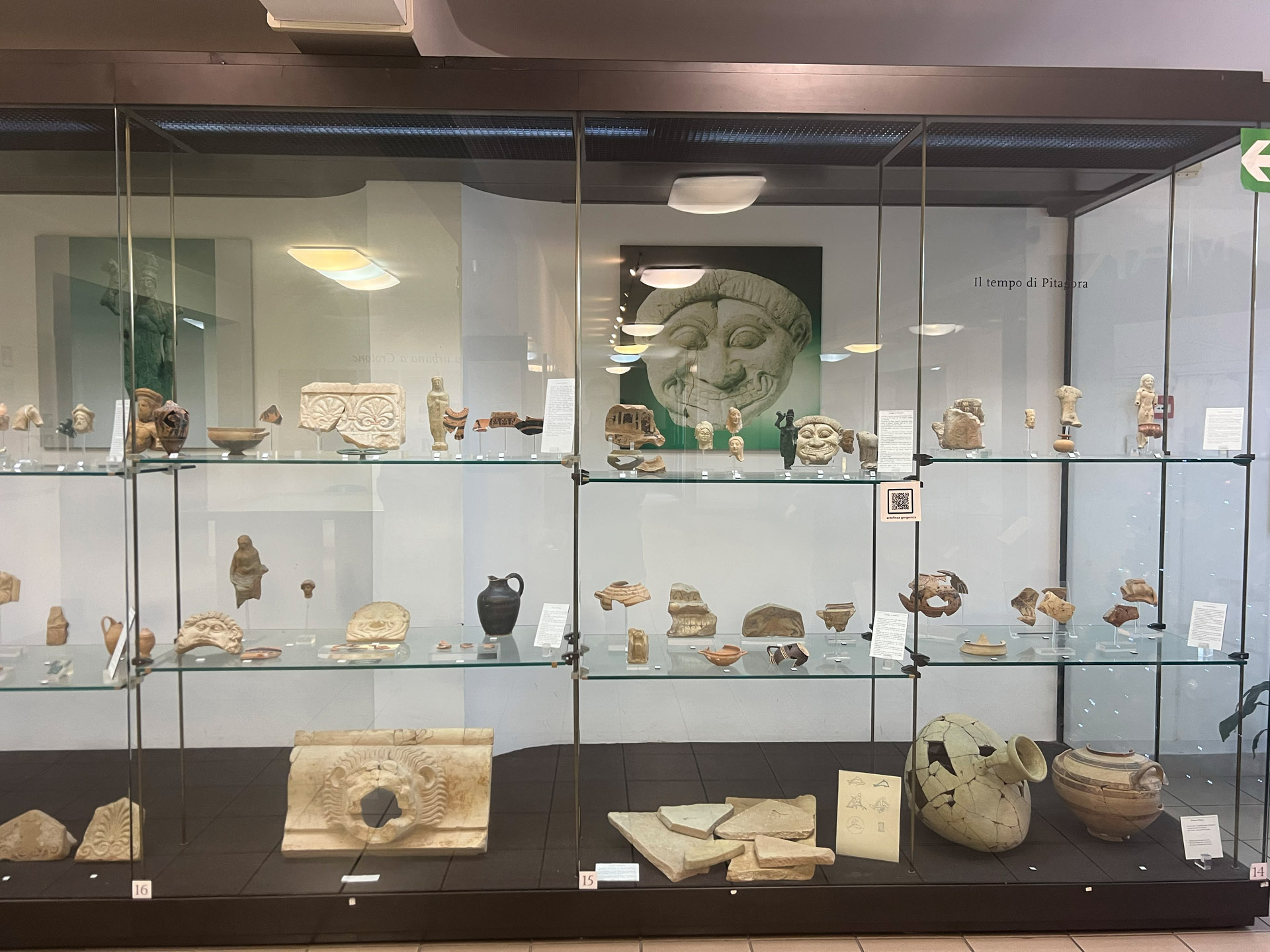
During the 6th and 5th centuries BC, Kroton reached the height of its political, cultural, and religious splendor. The city gradually distinguished itself through its civic organization, military power, the prestige of its athletes, and the vitality of its intellectual life, establishing itself as one of the leading city-states (poleis) of Magna Graecia. The arrival from Samos of the philosopher Pythagoras and the foundation of his school introduced new political, ethical, and religious ideals, helping to make Crotone not only a wealthy and powerful center but also a place of knowledge and harmony.
The spread of Pythagorean thought is associated with a decisive historical event in the life of Crotone: the defeat in 510 BC of its “twin” colony Sybaris, corrupted by decadent customs and lifestyles
... read more >During the 6th and 5th centuries BC, Kroton reached the height of its political, cultural, and religious splendor. The city gradually distinguished itself through its civic organization, military power, the prestige of its athletes, and the vitality of its intellectual life, establishing itself as one of the leading city-states (poleis) of Magna Graecia. The arrival from Samos of the philosopher Pythagoras and the foundation of his school introduced new political, ethical, and religious ideals, helping to make Crotone not only a wealthy and powerful center but also a place of knowledge and harmony.
The spread of Pythagorean thought is associated with a decisive historical event in the life of Crotone: the defeat in 510 BC of its “twin” colony Sybaris, corrupted by decadent customs and lifestyles entirely at odds with the strict principles that Kroton had succeeded in establishing. The city was thus able to extend its influence over much of the Ionian territory and to project itself into trade and cultural contacts with the Aegean world and the wider Mediterranean without rivals.
It was in this period that the cult of Apollo assumed a predominant role at the heart of public life, closely linked to civic identity through the symbol of the tripod, depicted on contemporary coinage and ceramic artefacts. Kroton also honored the god by competing successfully in the Pythian Games, one of the four major Panhellenic Games of ancient Greece, held every four years at Delphi. The city’s fame spread throughout the Mediterranean thanks to athletes such as Milo, seven-time victor at both the Pythian Games and the Olympic Games, and Phayllos, who triumphed three times at the Pythian Games and in several Panhellenic competitions. Through them, the renown of Kroton reached every corner of the Mediterranean world.
read less <