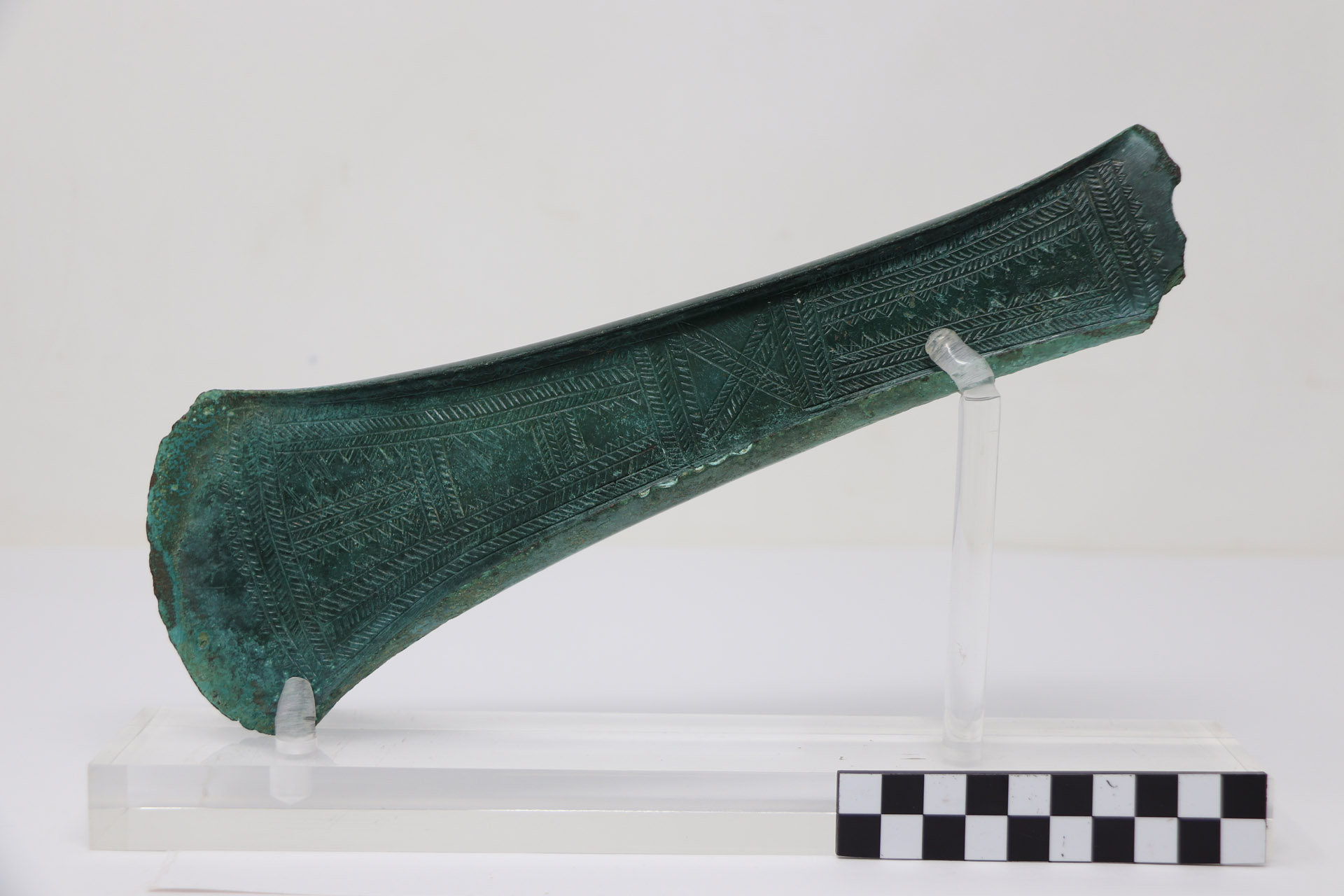
Bronze Axe Blade with Incised Decoration
Description
The blade, sharpened on one side only, has an elongated body with a wider section toward the cutting edge and a narrower one toward the heel; the edges are raised. The surface bears incised decoration
... read more >The blade, sharpened on one side only, has an elongated body with a wider section toward the cutting edge and a narrower one toward the heel; the edges are raised. The surface bears incised decoration composed of geometric motifs with lines and zigzags; near the center a panel with intersecting lines forming an X can be distinguished. No traces of the hafting survive, that is, the part by which the object was held.
This blade is one of two similar examples discovered in 1987 at Timpone delle Rose, in the territory of Roccabernarda (KR), where a probably male burial was uncovered. The tomb consisted of a simple pit covered by a mound of stones. Together with the blade, the funerary assemblage included two axes and a dagger with a cast handle, now lost.
The rich decoration on the blade suggests that it was not intended for everyday use, but rather functioned as an object of luxury and prestige. Indeed, the decoration would have been invisible if the weapon had been mounted on a handle, indicating a symbolic rather than a functional value. The Timpone delle Rose burial likely belonged to a prominent individual within the society of the time, a member of the emerging elite of the Bronze Age (ca. 2200–975 BC), whose wealth may have been linked to livestock breeding and metallurgical activities.
read less <INSIGHTS >
Explore the areas of Crotone and Sibari
History awaits you inside the Archaeological Sites of Crotone and Sibari. Start your visit.
planDiscover current events
Concerts, tastings and dedicated exhibitions to relive the history of Magna Graecia.
discover more
Experience the Parks and Museums
History awaits you inside the Archaeological Sites of Crotone and Sibari. Start your visit.
plan

Whether you are with family, at school or experience the world in a unique way, here you will find paths designed for you.