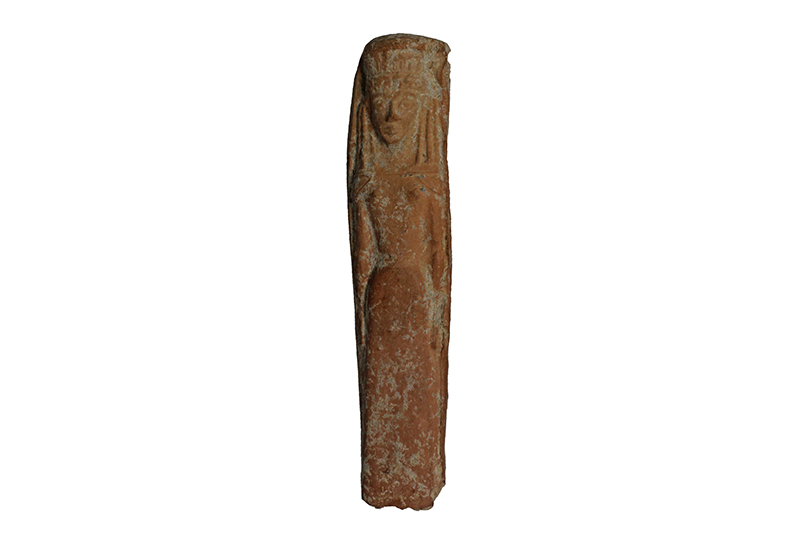
Female Terracotta Figurine
Where
Museo Archeologico Nazionale della Sibaritide
Località Casabianca – Frazione Sibari
87011 – Cassano All’Ionio (CS)
Description
The terracotta figurine depicts a standing female figure in frontal pose. The long arms, held close to the body, descend along the sides with open hands touching the garment. The face, oval and elongated
... read more >The terracotta figurine depicts a standing female figure in frontal pose. The long arms, held close to the body, descend along the sides with open hands touching the garment. The face, oval and elongated with a pronounced chin, displays regular features: large incised eyes surmounted by strongly marked eyebrows, a straight nose, and small ears. The hair, rendered as beaded braids, falls neatly over the shoulders, while two rows of curls frame the forehead. On the head rests a tall, rigid headdress (polos), decorated with tongue-shaped motifs and supported by a thin fillet. The figure wears a long garment, hemmed at the bottom with an embroidered band that almost completely conceals the feet, and a sleeveless dress (peplos), cinched at the waist by a high belt. A small cloak (epiblema) drapes over the shoulders, leaving the arms uncovered and lending the figure a solemn appearance.
The figurine comes from the Sanctuary of Timpone Motta, at Francavilla Marittima. It belongs to the category of pinakes and devotional terracottas, mold-made objects widely distributed in the Greek sanctuaries of the Western Mediterranean. Such items were offered to the deity as ex votos, especially by young women participating in rites of passage connected with marriage (gamos), in order to invoke the protection of the goddess. These female figurines, often similar in posture and attire, expressed an ideal of beauty and composure while simultaneously reflecting the prestige and devotion of the dedicants.
The artifact is part of the so-called “Berne–Malibu” group, a collection of more than 5,000 objects—including bronzes, ceramics, and terracottas—clandestinely looted from the sanctuary at Francavilla Marittima and subsequently introduced into the illicit antiquities market. Acquired by the J. Paul Getty Museum in Malibu and by the University of Bern (Institute of Classical Archaeology), these objects were returned to Italy in 2001 following a lengthy investigative effort by the Italian Carabinieri’s Cultural Heritage Protection Unit.
read less <INSIGHTS >
Explore the areas of Crotone and Sibari
History awaits you inside the Archaeological Sites of Crotone and Sibari. Start your visit.
planDiscover current events
Concerts, tastings and dedicated exhibitions to relive the history of Magna Graecia.
discover more
Experience the Parks and Museums
History awaits you inside the Archaeological Sites of Crotone and Sibari. Start your visit.
plan

Whether you are with family, at school or experience the world in a unique way, here you will find paths designed for you.