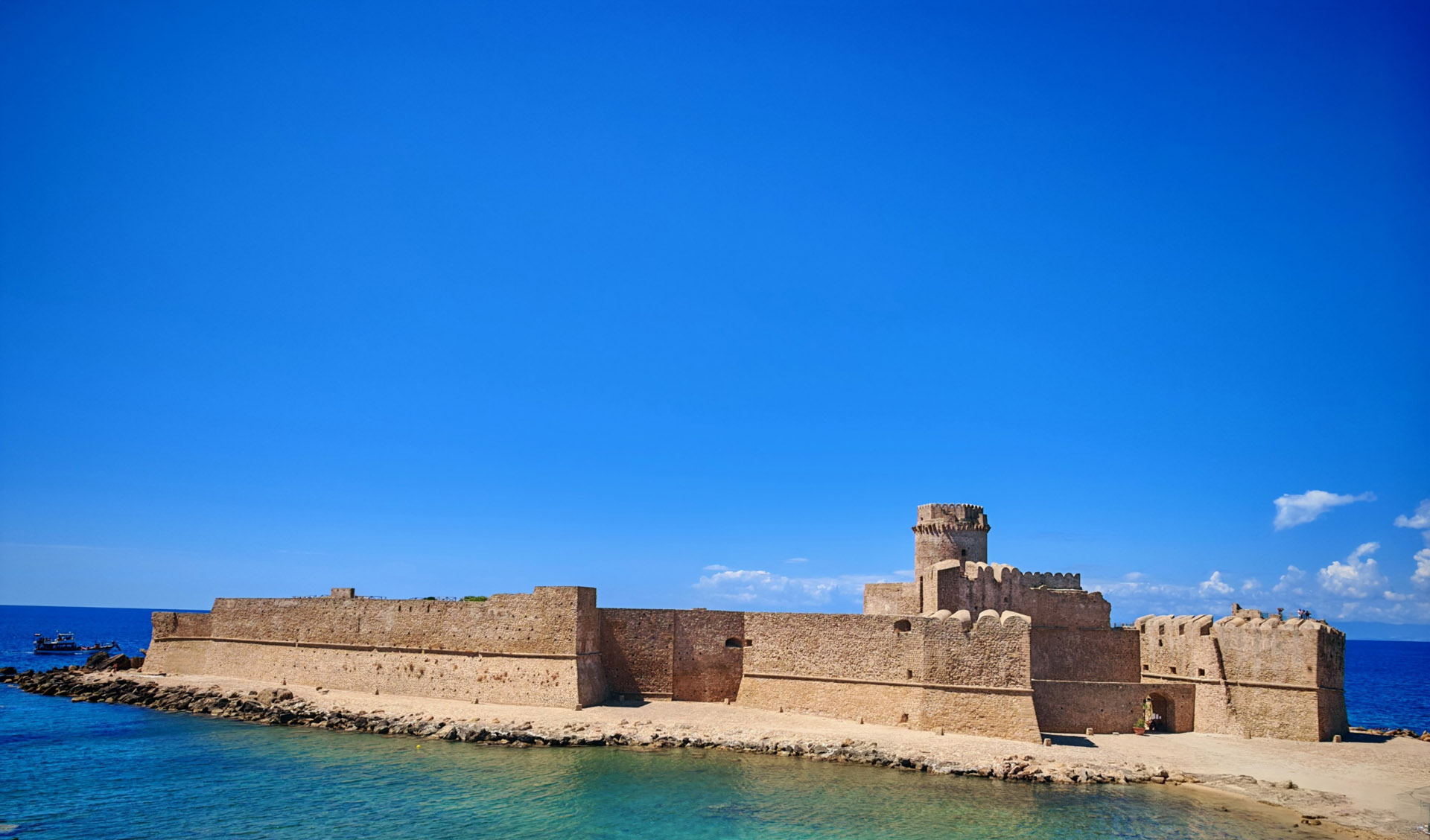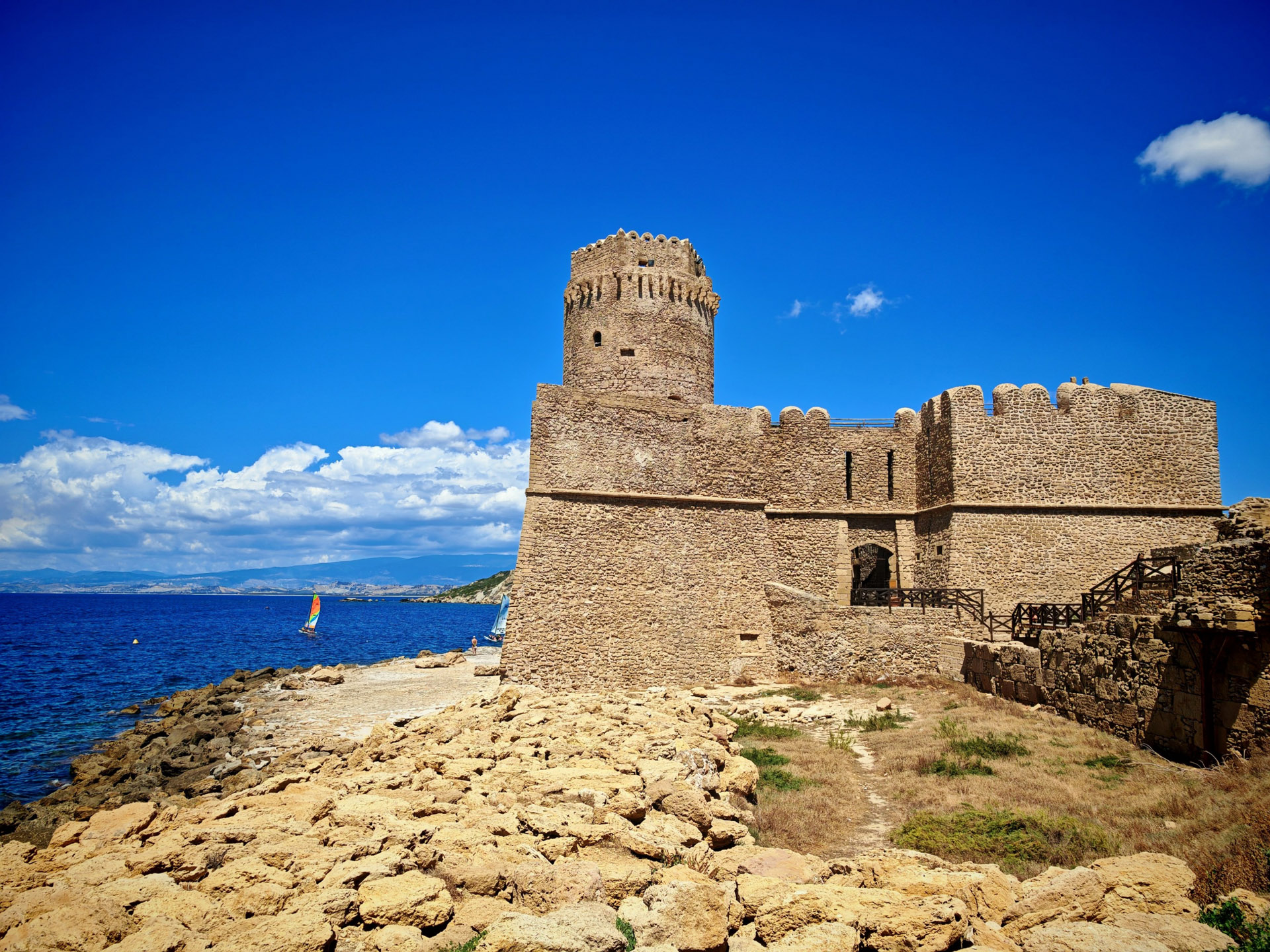
Today, the reconstruction of the history of Le Castella is made possible thanks to archival documentation—medieval chronicles, notarial deeds, feudal registers, and military reports—which allow the site’s evolution over the centuries to be traced with precision. Without these valuable records, preserved in the archives of Naples, Catanzaro, and Crotone, it would be impossible to fully understand the strategic and political importance of one of the most fascinating coastal fortresses in southern Italy.
The first certain attestation of the toponym Le Castella dates to 1154, when the great Arab geographer al-Idrīsī, in his celebrated Book of Roger (Kitāb Rujār), mentions a place called Qas’tal, located thirteen miles from Crotone. This exceptionally important source shows that the
... read more >Today, the reconstruction of the history of Le Castella is made possible thanks to archival documentation—medieval chronicles, notarial deeds, feudal registers, and military reports—which allow the site’s evolution over the centuries to be traced with precision. Without these valuable records, preserved in the archives of Naples, Catanzaro, and Crotone, it would be impossible to fully understand the strategic and political importance of one of the most fascinating coastal fortresses in southern Italy.
The first certain attestation of the toponym Le Castella dates to 1154, when the great Arab geographer al-Idrīsī, in his celebrated Book of Roger (Kitāb Rujār), mentions a place called Qas’tal, located thirteen miles from Crotone. This exceptionally important source shows that the site was already known and recognized at that time as a strategic point along the Ionian coast of Calabria.
During the 13th century, Le Castella became the scene of numerous military events linked to the struggles between the Angevins and the Aragonese. During the War of the Vespers, in 1290, the fortress was besieged for eight days by Ruggero di Lauria, admiral in the service of the Crown of Aragon, who captured it from Pietro Ruffo, Count of Catanzaro and supporter of the Angevins. Two years later, Lauria himself gathered thirty galleys there, a clear sign of the strategic value of the harbor and the stronghold, which controlled a wide stretch of the Ionian Sea.
With the Peace of Caltabellotta (1309), Le Castella returned under the County of Catanzaro and remained firmly held by the powerful Ruffo family, passing from generation to generation without significant events until the mid-15th century.
Chronicles mention Le Castella again around 1444–1445, when the fief came under the control of Antonio Centelles, Count of Catanzaro through his marriage to Enrichetta Ruffo, the last heir of the family. Centelles, a leading figure in the baronial revolts against King Alfonso of Aragon, transformed the fortress into an important military stronghold, which became the scene of sieges and clashes during the tensions between the Calabrian nobility and the Aragonese monarchy.
After the suppression of the revolts, Le Castella returned to the royal demesne. In March 1489, the Duke of Calabria, Alfonso (the future Alfonso II of Naples), accompanied by the military architect Antonio Marchesi da Settingiano, personally visited the fortress as part of an inspection campaign of the Kingdom’s coastal defenses. This visit testifies to the Aragonese monarchy’s awareness of the strategic importance of this maritime stronghold, located at a key point between the Gulf of Squillace and Capo Rizzuto.
In 1496, the fief was granted in perpetuum, that is, in perpetuity, to Andrea Carafa, Count of Santa Severina, who launched an extensive program to reorganize the fortifications of his domains. At Le Castella, Carafa promoted the construction of a new seaside fortress, designed according to the most advanced principles of Renaissance military architecture. The new complex incorporated the ancient circular tower and featured a quadrangular keep flanked by four arrowhead-shaped corner bastions, typical of early 16th-century defensive structures conceived to withstand artillery fire.
The decline of the fortress began as early as the second half of the 16th century. Repeated Ottoman and Barbary raids along the Calabrian coasts led to the depopulation of the settlement and the gradual abandonment of the site. In 1558, the new feudal lord Ferrante Carafa, Duke of Nocera, even ordered the dismantling of the fortifications, signaling a shift in defensive strategies and a growing sense of insecurity in the region.
By the end of the 18th century, the islet of Le Castella appears to have been definitively abandoned, yet its ruins continue to evoke the glorious past of a place that once stood at the crossroads of trade, warfare, and power.
read less <