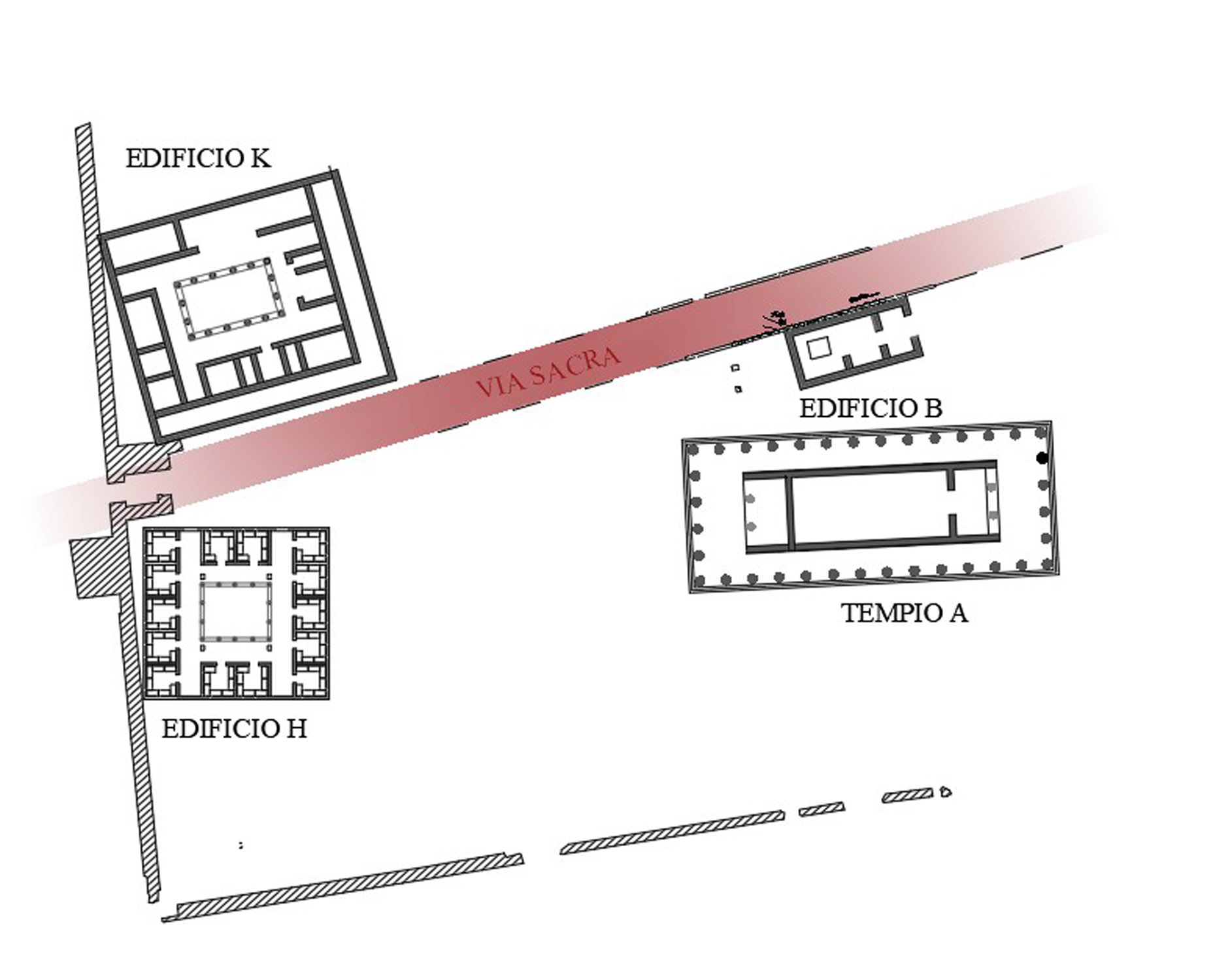
The worshippers who traveled from the city of Kroton to the sanctuary on the occasion of festivals followed a long processional road, the final stretch of which has been identified within the Park. This is the so-called Via Sacra, 8.50 meters wide and oriented east–west, which crossed the sanctuary and led pilgrims to their final destination, Temple A, and possibly to its associated altar.
Its construction dates to 500–475 BC, a period of major monumentalization of the area. In particular, the road appears to be contemporary with the final phase of Building B, to which it is aligned. Near this structure, a section of the road approximately 58 meters long is still partially visible. Composed of superimposed layers of silt and sandy soil mixed with bricks and ceramic fragments, the road was
... read more >The worshippers who traveled from the city of Kroton to the sanctuary on the occasion of festivals followed a long processional road, the final stretch of which has been identified within the Park. This is the so-called Via Sacra, 8.50 meters wide and oriented east–west, which crossed the sanctuary and led pilgrims to their final destination, Temple A, and possibly to its associated altar.
Its construction dates to 500–475 BC, a period of major monumentalization of the area. In particular, the road appears to be contemporary with the final phase of Building B, to which it is aligned. Near this structure, a section of the road approximately 58 meters long is still partially visible. Composed of superimposed layers of silt and sandy soil mixed with bricks and ceramic fragments, the road was rebuilt several times after the Classical period—first in the 3rd century BC and then on multiple occasions up to Late Antiquity.
read less <