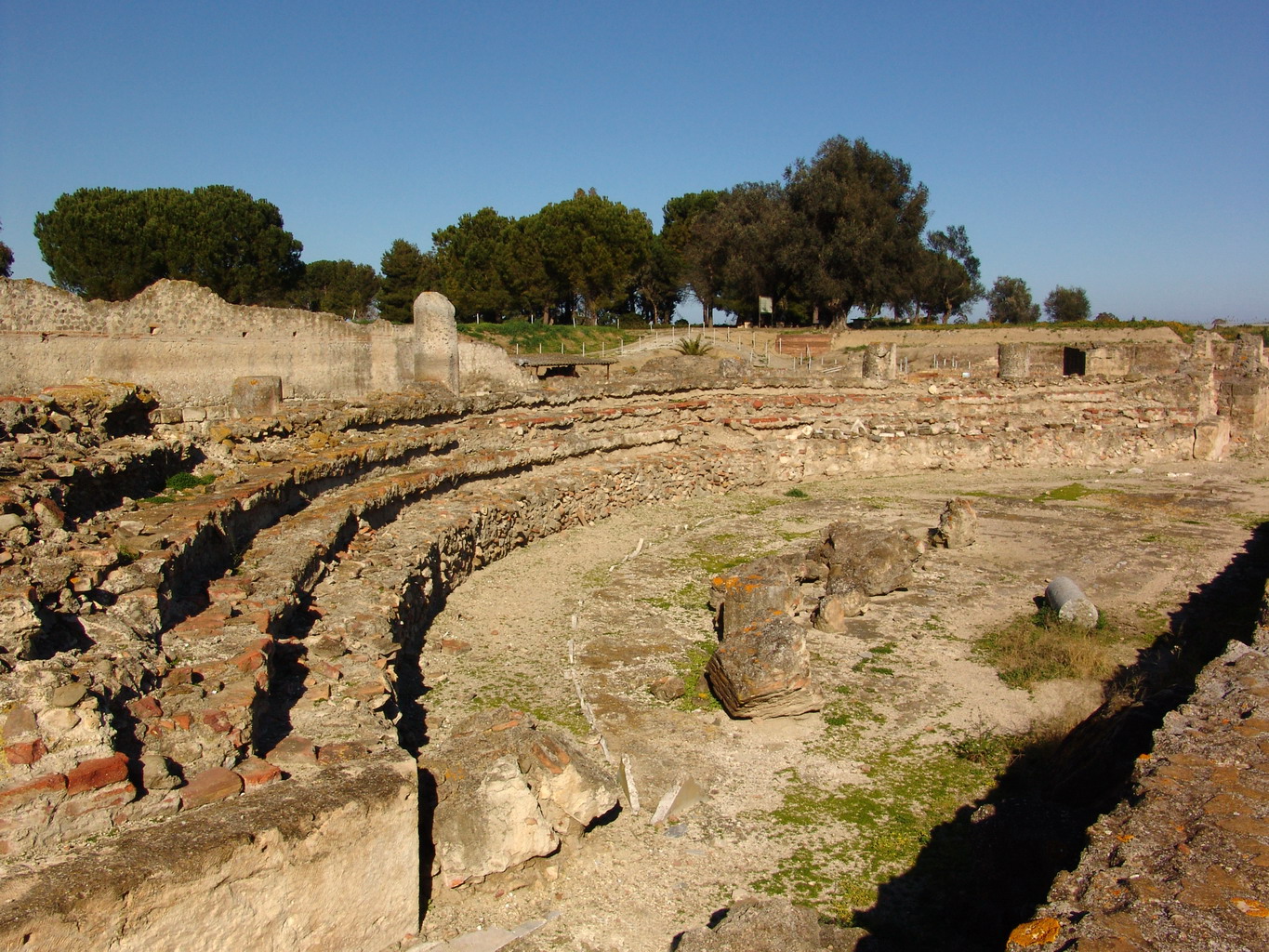
Among the best-preserved structures in the archaeological area of Sybaris–Thurii–Copiae, the semicircular theatre stands out for its size and architectural complexity. It is the most imposing public building of the city, located at the intersection of the two main road axes, oriented respectively north–south and east–west. This location was not accidental, but the result of a precise urban plan aimed at integrating civic spaces into the daily life of the city.
The construction of the building dates to the late Republican period, around 50 BC. In this initial phase, it appeared as a large semicircular structure, with a monumental colonnade along the curved side, composed of smooth columns surmounted by capitals decorated with leaf motifs, probably of the Corinthian order. The straight
... read more >Among the best-preserved structures in the archaeological area of Sybaris–Thurii–Copiae, the semicircular theatre stands out for its size and architectural complexity. It is the most imposing public building of the city, located at the intersection of the two main road axes, oriented respectively north–south and east–west. This location was not accidental, but the result of a precise urban plan aimed at integrating civic spaces into the daily life of the city.
The construction of the building dates to the late Republican period, around 50 BC. In this initial phase, it appeared as a large semicircular structure, with a monumental colonnade along the curved side, composed of smooth columns surmounted by capitals decorated with leaf motifs, probably of the Corinthian order. The straight side, facing one of the main streets, was instead defined by a portico that served as an access space and as a connection with the urban fabric.
Over time, and in response to the social and cultural changes of the Imperial period, the building underwent major transformations. Around AD 50, roughly a century after its construction, it was converted into a theatre. The curved wall was raised and reinforced with new masonry structures, necessary to support the weight of the seating tiers (cavea) intended for the audience. The former street-facing portico was closed and transformed into the orchestra, the semicircular area in front of the stage reserved for spectators of high status, decorated with floors of fine colored marbles.
The opposite side of the building was adapted into the stage area. Here stood a stage decorated with apsidal walls and enriched by a series of sculptural ornaments, including marble statues and vegetal friezes, reflecting refined taste and a strong connection with Roman architectural models. The evolution of the semicircular theatre thus reflects not only changing functional needs within the city, but also the progressive establishment of Roman culture in a territory deeply marked by Greek heritage. In its final form, the building represents a perfect example of architectural and cultural fusion, in which local identity engages in dialogue with the innovations of the Empire.
read less <