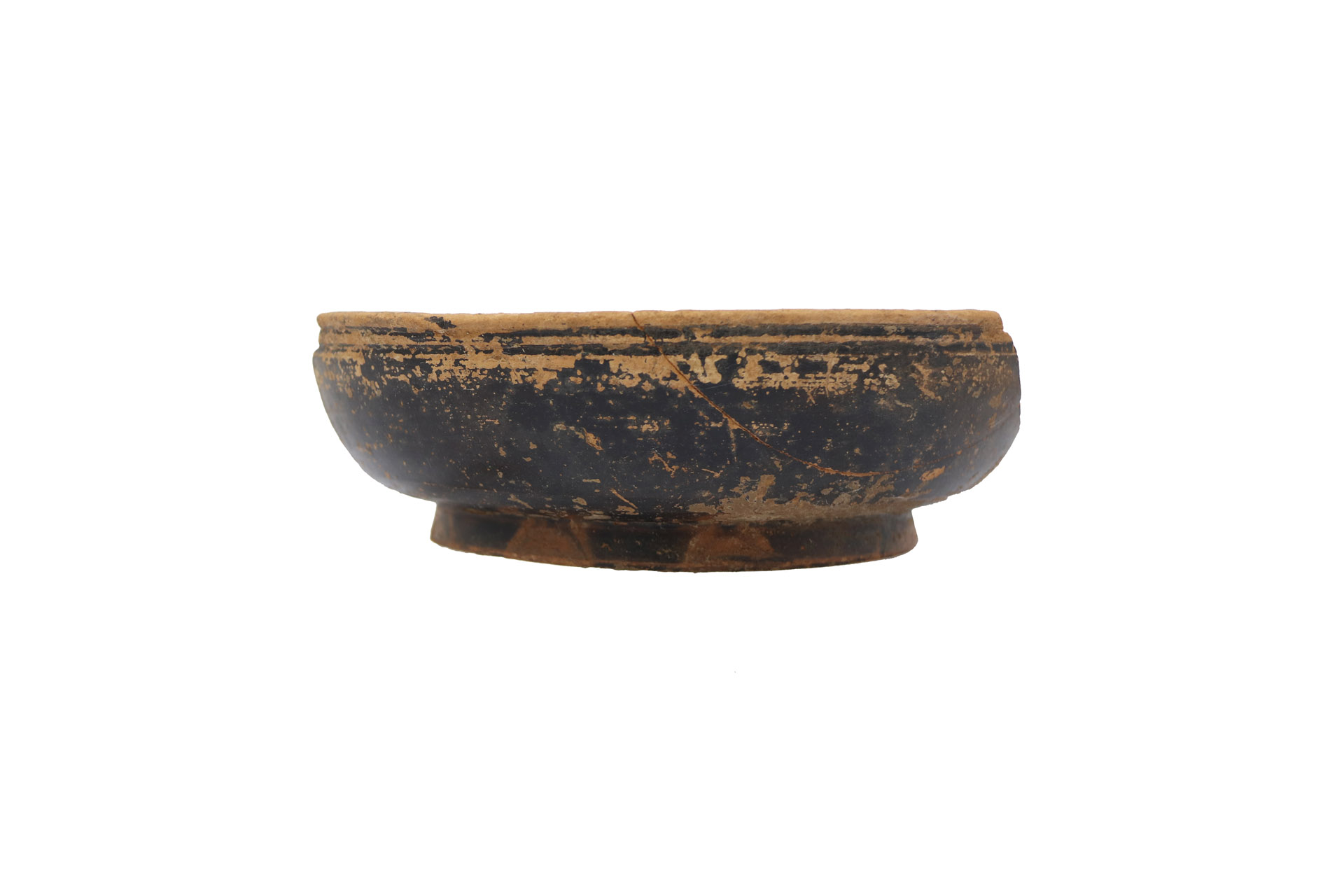
Black-Gloss Ceramic Cup
Where
Museo Archeologico Nazionale di Capo Colonna
Via Michele Di Donato 1
(Già Via Hera Lacinia)
88900 – Crotone (KR)
Description
Cup (drinking vessel) in Campanian black-gloss pottery, with a shallow bowl and a ring foot.
The cup belongs to the class known as “Campana B–oid”, characterized by a well-refined, light brown (hazelnut-colored)
... read more >Cup (drinking vessel) in Campanian black-gloss pottery, with a shallow bowl and a ring foot.
The cup belongs to the class known as “Campana B–oid”, characterized by a well-refined, light brown (hazelnut-colored) fabric and a rather matte black slip. This type falls within the broader group of Roman black-gloss wares, which constituted the main category of fine tableware between the late 3rd and the 1st century BC and spread widely throughout the Mediterranean after the Second Punic War. Campanian pottery, originally produced in what is now Campania, became especially prominent for the variety of its forms, the quality of its slip, and its ability to combine elegance with serial production.
The term “Campana B–oid” refers to forms that imitate or vary from the Campana B type and were produced regionally by numerous workshops, achieving very wide distribution. At Capo Colonna, examples of this ceramic class come mainly from the Hellenistic Buildings H and K (the hestiatorion and katagogion), as well as from the residential quarter known as Area G/2000. They consist chiefly of bowls (patere), small cylindrical containers (pyxides), and small cups with various rim and foot types, all dating to a chronological horizon between the 2nd and 1st centuries BC.
read less <INSIGHTS >
Explore the areas of Crotone and Sibari
History awaits you inside the Archaeological Sites of Crotone and Sibari. Start your visit.
planDiscover current events
Concerts, tastings and dedicated exhibitions to relive the history of Magna Graecia.
discover more
Experience the Parks and Museums
History awaits you inside the Archaeological Sites of Crotone and Sibari. Start your visit.
plan

Whether you are with family, at school or experience the world in a unique way, here you will find paths designed for you.