Bronze Statuette of a Nude Warrior
Description
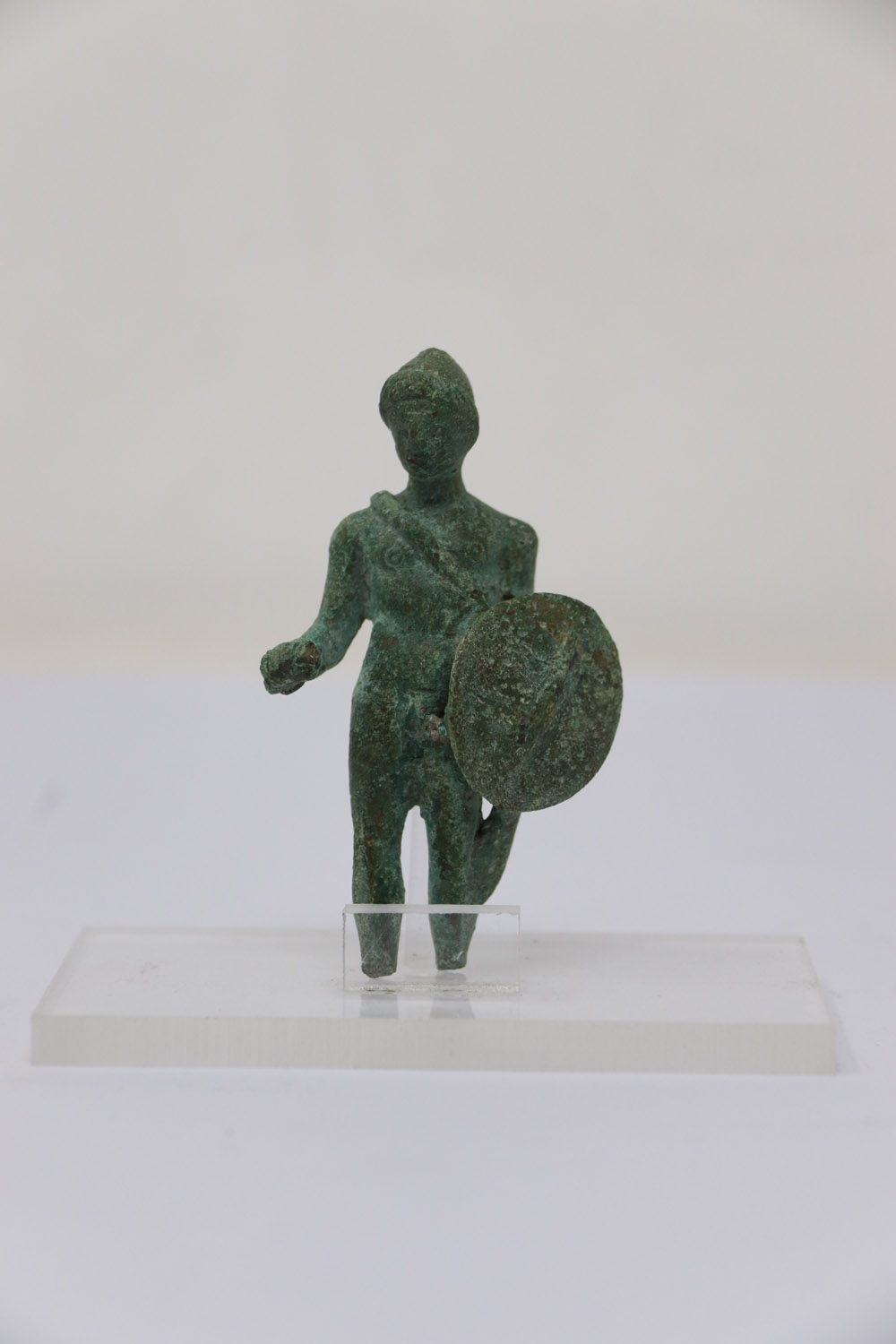
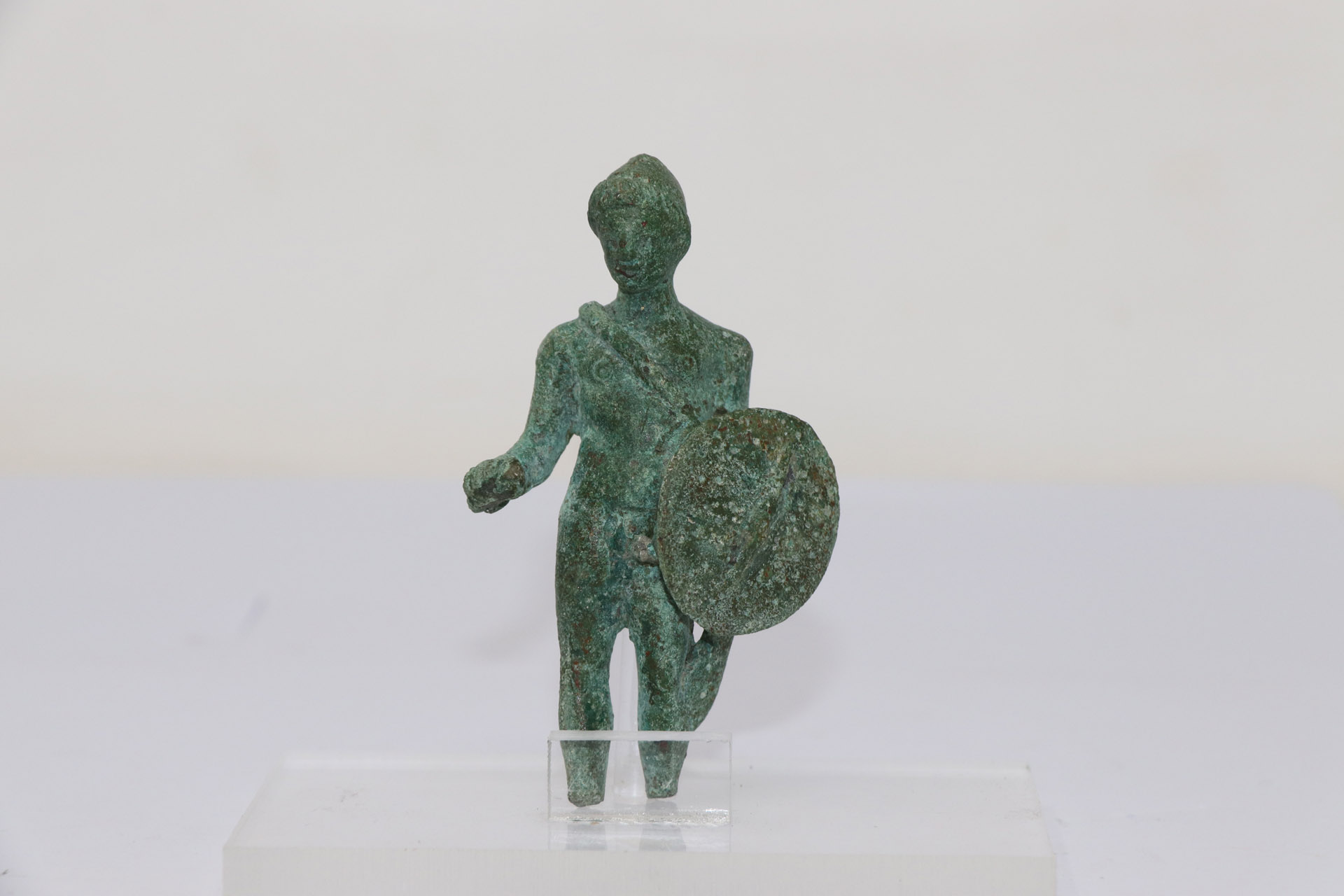
The statuette depicts a nude youth holding a round shield and wearing a shoulder strap (balteus) that supports a scabbard. The head is slightly turned to the right and appears to be covered by a close-fitting
... read more >The statuette depicts a nude youth holding a round shield and wearing a shoulder strap (balteus) that supports a scabbard. The head is slightly turned to the right and appears to be covered by a close-fitting cap from which a uniform mass of hair emerges. The face shows signs of denting and heavy wear: the orbital cavities are visible but the eyeballs are missing; the nose is short and broad, and the lips are full. The right arm is extended forward, and the hand grasps an object of which only a small trace remains. In the left arm, the figure holds a small round shield with a slender central boss. The balteus is worn diagonally across the torso and supports a small object. The body’s weight rests on the right leg, while the left is slightly set back; the feet are not preserved. The statuette was made using the solid casting technique, with a two-part mold, and was partially cold-finished with a scraper and chisel.
The statuette was found during excavations carried out between 2006 and 2008 over a large area of the hill of Via Poggioreale, in the zone of the former Civil Hospital of Crotone, now the site of the new Municipal Theatre. Archaeological investigations revealed a long continuity of occupation in the area: from the Classical Greek period (5th–early 4th century BC) and the Hellenistic period (4th–2nd century BC), through the Roman Imperial period (1st–5th century AD), and, after a phase of abandonment, into the Middle Ages (13th–14th century AD).
The object comes from a sector that yielded various items of a votive nature, suggesting the presence of a sacred area. The statuette itself may have been a votive offering, or part of one. However, the uneven patina, the slight imbalance of the figure, and the lack of finishing on the face and other parts of the body may indicate that it was an unfinished artisanal product, discarded on site.
read less <INSIGHTS >
Explore the areas of Crotone and Sibari
History awaits you inside the Archaeological Sites of Crotone and Sibari. Start your visit.
planDiscover current events
Concerts, tastings and dedicated exhibitions to relive the history of Magna Graecia.
discover more
Experience the Parks and Museums
History awaits you inside the Archaeological Sites of Crotone and Sibari. Start your visit.
plan

Whether you are with family, at school or experience the world in a unique way, here you will find paths designed for you.