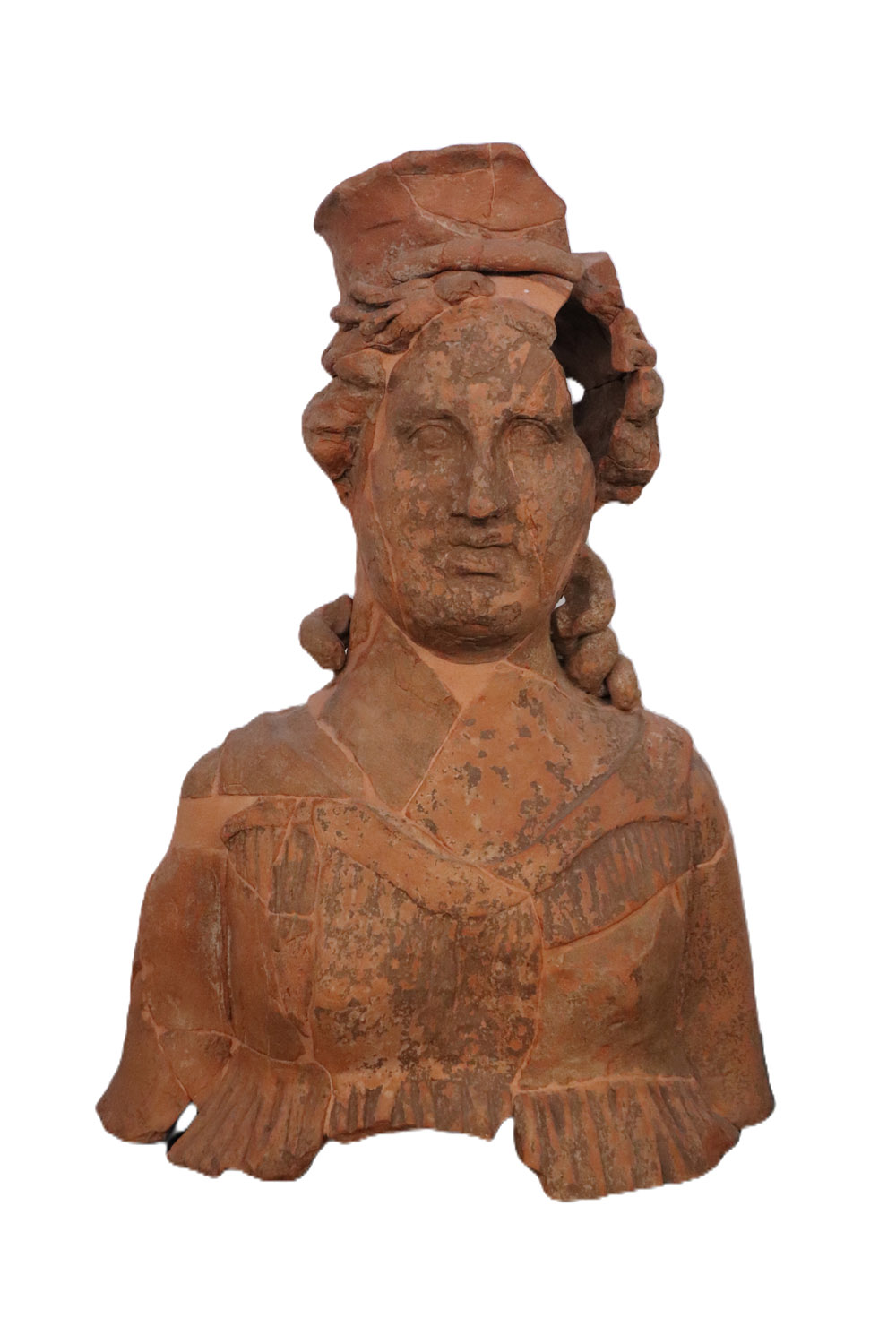
Female Bust in Terracotta
Where
Museo Archeologico Nazionale di Capo Colonna
Via Michele Di Donato 1
(Già Via Hera Lacinia)
88900 – Crotone (KR)
Description
Terracotta female bust, probably representing a female divinity, hand-modelled and finished with a spatula. Cut just below the breasts, it is conceived frontally, with the head slightly inclined to the
... read more >Terracotta female bust, probably representing a female divinity, hand-modelled and finished with a spatula. Cut just below the breasts, it is conceived frontally, with the head slightly inclined to the right, a pose that conveys a sense of naturalism and movement. The face, oval and full, features strong and plastic facial traits: small eyes with raised eyelids, lightly suggested eyebrows and lateral eye folds, a straight nose, a slightly open mouth with full lips, and a massive chin and neck.
The hairstyle is elaborate: the wavy hair, held by a fillet, emerges laterally from beneath a cylindrical headdress (polos), framing the face and partially covering the ears, before falling into large applied curls along the sides of the neck. The figure wears a light chiton with a wide neckline and short sleeves, gathered beneath the breasts by a belt.
The bust was found inside a domestic space, in a sector of the Roman settlement known as Area G–2000. The context of discovery suggests that the object belonged to the furnishings of a domus and had a symbolic or religious function, connected with practices of household cult. On stylistic grounds and considering the quality of workmanship, the bust fits within the artistic production of southern Italy and Sicily between the 4th and 3rd centuries BC. Some particularly refined details indicate that it was not a mass-produced object, but rather a special piece made with care. For these reasons, the bust finds close parallels with well-known examples discovered at Valle Ariccia (Latium), dated to the late 4th century BC. These works reveal the interaction of different artistic traditions: on the one hand, the elegance and refinement of southern Italian art; on the other, influences from Sicily, especially from the area of Syracuse.
read less <INSIGHTS >
Explore the areas of Crotone and Sibari
History awaits you inside the Archaeological Sites of Crotone and Sibari. Start your visit.
planDiscover current events
Concerts, tastings and dedicated exhibitions to relive the history of Magna Graecia.
discover more
Experience the Parks and Museums
History awaits you inside the Archaeological Sites of Crotone and Sibari. Start your visit.
plan

Whether you are with family, at school or experience the world in a unique way, here you will find paths designed for you.