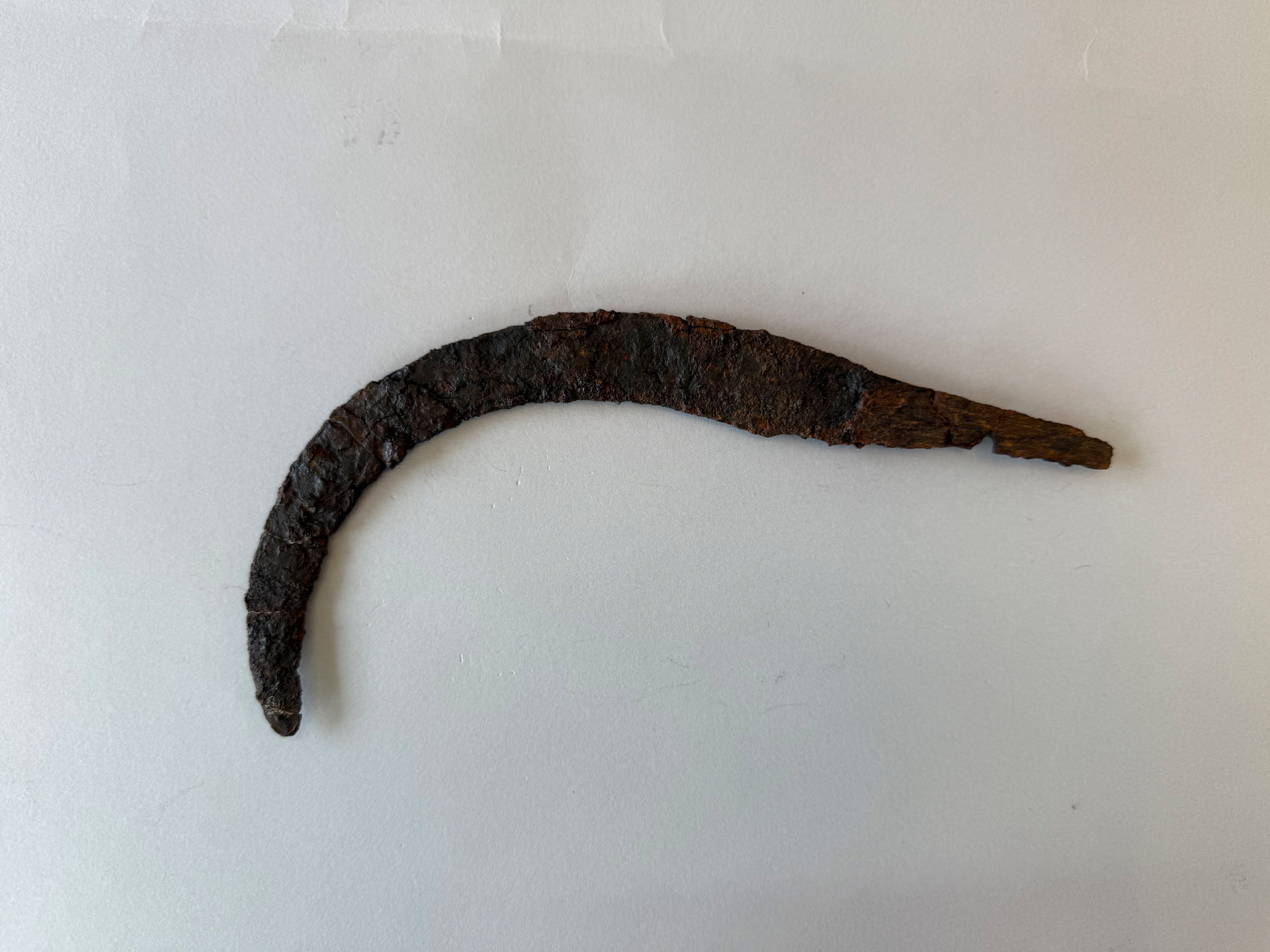
Iron Sickle
Where
Museo Archeologico Nazionale di Amendolara
Piazza Giovanni XXIII
87071 – Amendolara (CS)
Description
The sickle, found in fragments, has been reassembled. The blade is heavily corroded and has a curved profile, with a tapered inner edge and a flattened tip. The tang for the handle gradually becomes thinner
... read more >The sickle, found in fragments, has been reassembled. The blade is heavily corroded and has a curved profile, with a tapered inner edge and a flattened tip. The tang for the handle gradually becomes thinner toward the end.
Tomb 100 dates to the earliest phase of use of the Paladino Ovest necropolis (700–665 BC). It consisted of a rectangular pit cut into the ground and lined with stones. Thanks to the detailed documentation produced by Juliette de La Genière during the archaeological excavation, the exact position of the grave goods is known: this sickle, in particular, was placed at the end of the grave, behind the head of the deceased.
The sickle was a tool used for pruning and harvesting and is found in some male burials of 8th–7th century BC necropolises in Basilicata and northern Calabria. In the case of Tomb 100, it was accompanied by a spear, a brooch (fibula), and several ceramic vessels. The presence of these objects suggests that the deceased was an adult man involved in the productive life of the community, as well as in its military defense.
read less <INSIGHTS >
Explore the areas of Crotone and Sibari
History awaits you inside the Archaeological Sites of Crotone and Sibari. Start your visit.
planDiscover current events
Concerts, tastings and dedicated exhibitions to relive the history of Magna Graecia.
discover more
Experience the Parks and Museums
History awaits you inside the Archaeological Sites of Crotone and Sibari. Start your visit.
plan

Whether you are with family, at school or experience the world in a unique way, here you will find paths designed for you.