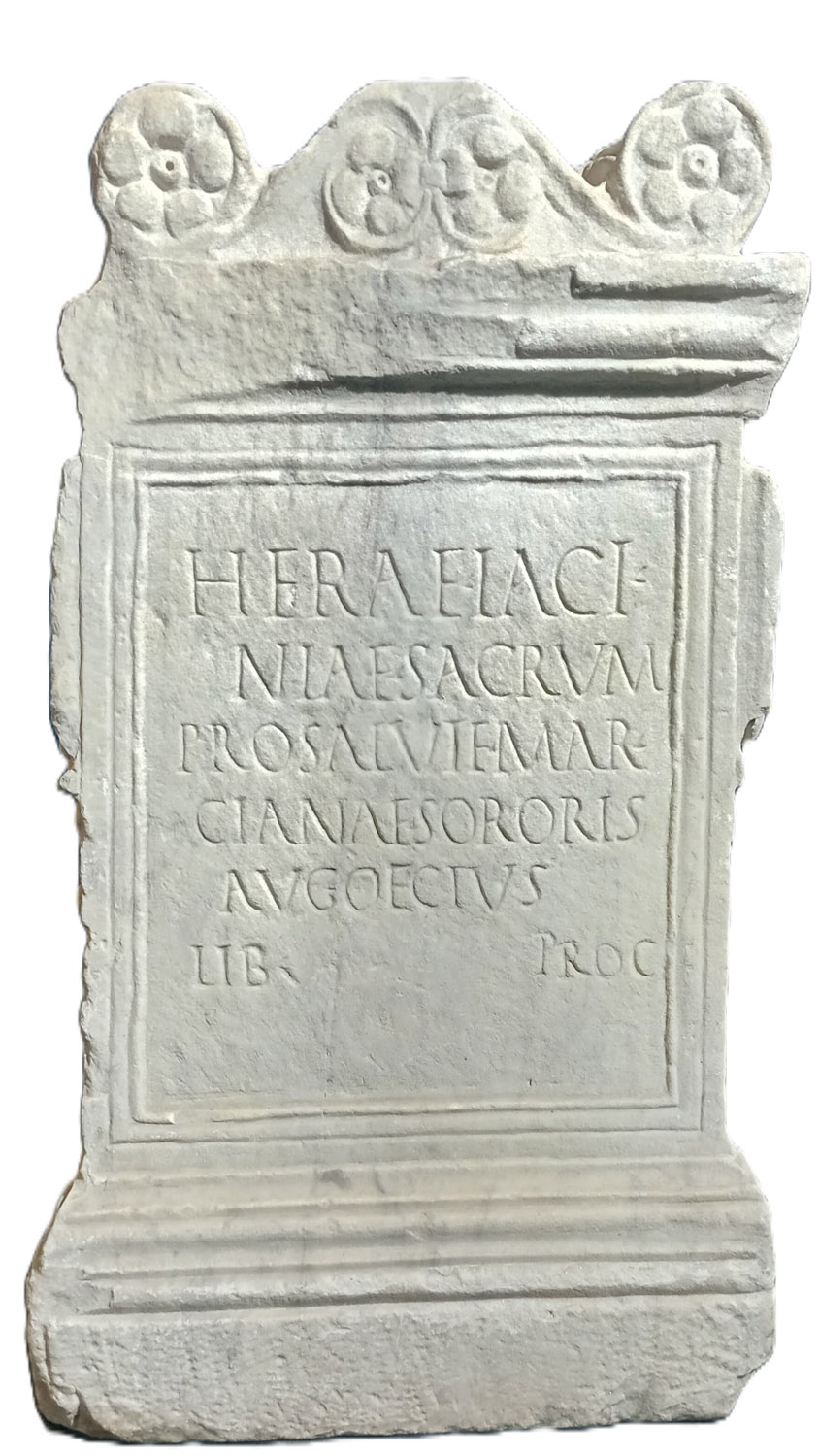
Votive Altar with Latin Inscription
Where
Museo Archeologico Nazionale di Capo Colonna
Via Michele Di Donato 1
(Già Via Hera Lacinia)
88900 – Crotone (KR)
Description
Marble altar (ara), decorated on three sides with stylized garlands of fruit and leaves suspended between bovine skulls (bucrania). On the main face, enclosed within thin linear frames, there is a Latin
... read more >Marble altar (ara), decorated on three sides with stylized garlands of fruit and leaves suspended between bovine skulls (bucrania). On the main face, enclosed within thin linear frames, there is a Latin inscription arranged in six lines, which reads:
“To Hera Lacinia, for the health of Marciana, sister of the Augustus. Oecius, freedman, procurator.”
The altar was discovered accidentally in 1843 at an unspecified location on the Capo Colonna promontory, at a time when the sanctuary had not yet been the subject of systematic archaeological excavations. The inscription commemorates a dedication to Hera Lacinia made by Oecius, an imperial freedman—that is, a former slave who had been manumitted and remained under the patronage of the imperial household. In the dedication, Oecius entrusts to the goddess the protection and well-being of Ulpia Marciana, sister of the emperor Trajan. This altar therefore represents a valuable testament to the continuity and vitality of the cult of Hera, which was still fully active in the 2nd century AD.
read less <INSIGHTS >
Explore the areas of Crotone and Sibari
History awaits you inside the Archaeological Sites of Crotone and Sibari. Start your visit.
planDiscover current events
Concerts, tastings and dedicated exhibitions to relive the history of Magna Graecia.
discover more
Experience the Parks and Museums
History awaits you inside the Archaeological Sites of Crotone and Sibari. Start your visit.
plan

Whether you are with family, at school or experience the world in a unique way, here you will find paths designed for you.